

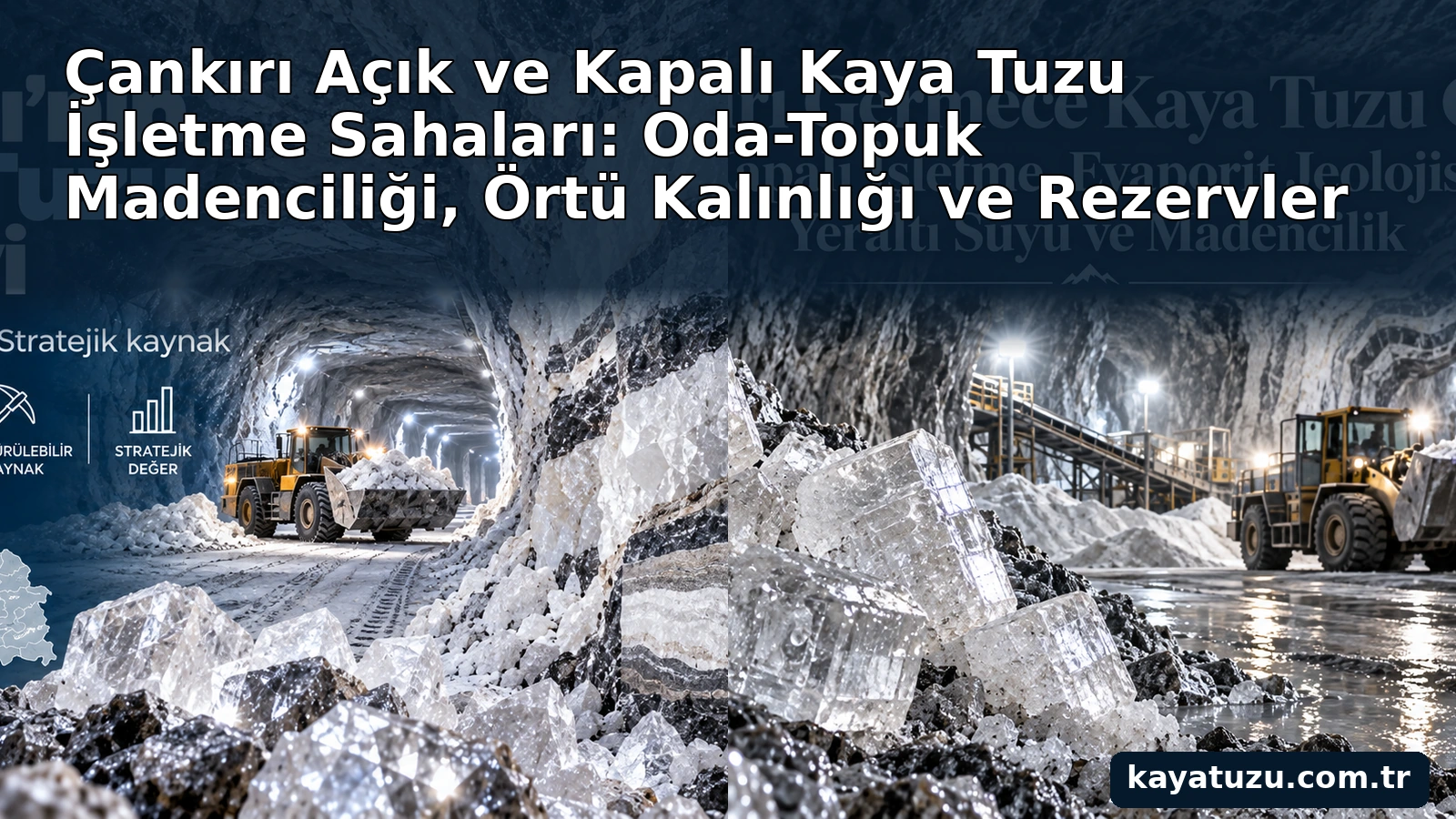
Çankırı’s open and underground rock-salt mining areas illustrate how the same evaporite basin can require different extraction strategies depending on geology and depth.
Why Mining Method Changes
A salt body close to the surface with limited overburden may be considered for surface-oriented extraction, while a deeper deposit may be accessed through underground galleries. The decision depends on economics, safety, geometry and environmental constraints as well as depth.
Room-and-Pillar Mining
In underground salt mining, rooms are excavated while pillars of salt remain to support the roof. Mine design determines pillar dimensions, extraction ratio and long-term stability.
Overburden Thickness
Overburden controls how easily a deposit can be reached from the surface. It also affects groundwater pathways, stripping requirements and the geotechnical conditions of mining.
Reserves and Geological Resources
Large quantities of geological salt do not automatically equal mineable reserves. Reserve classification requires adequate drilling, continuity, quality data, engineering assumptions and economic evaluation.
Çankırı Research Programme
Historical MTA work in Çankırı mapped a broad area and used geological surveys, prospecting, galleries, saline springs, boreholes and geophysical methods to distinguish areas with different mining characteristics.