

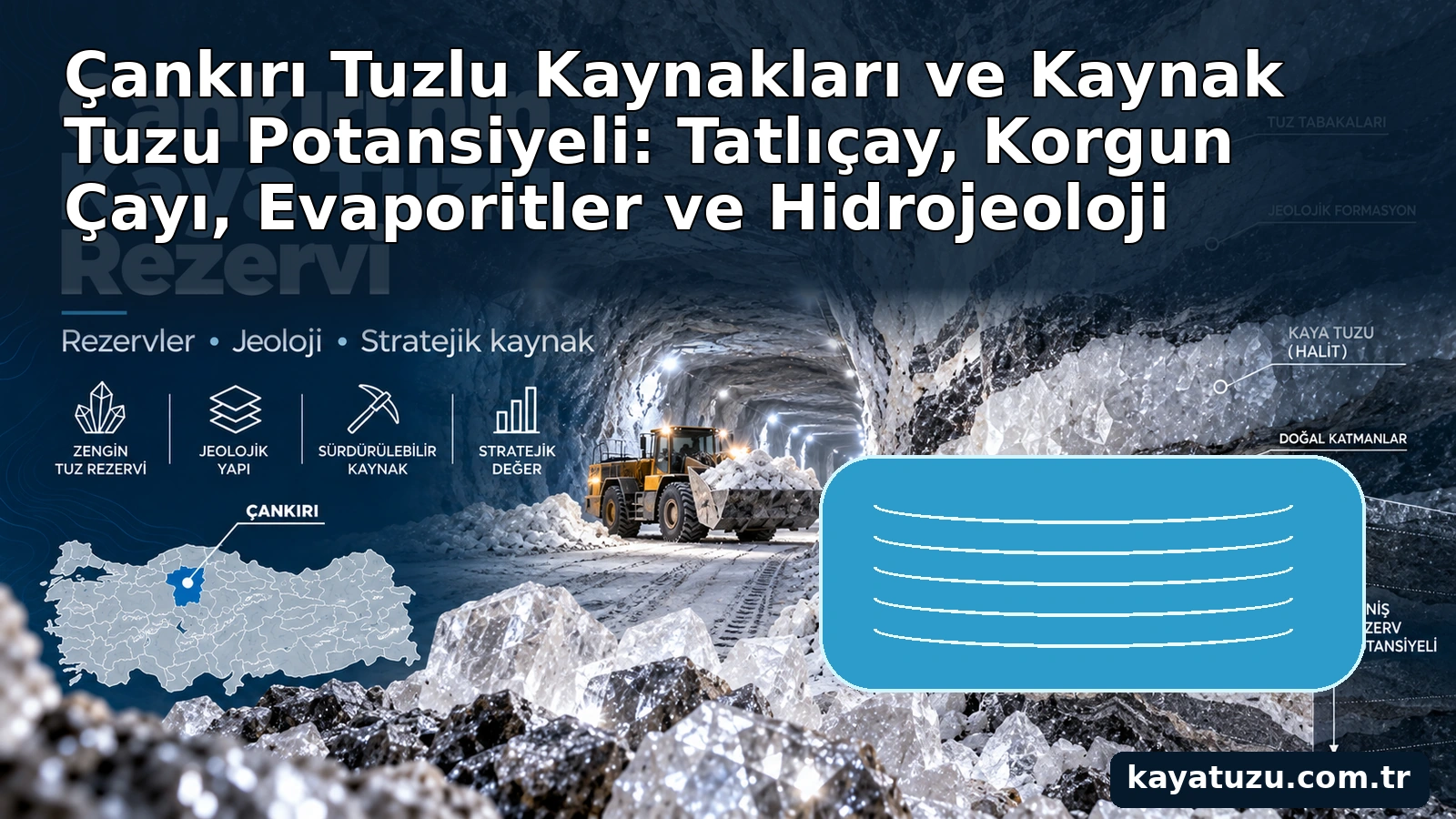
Çankırı Saline Springs and Spring-Salt Potential examines the water side of the Çankırı evaporite basin. Rock salt is not only mined as a solid material; groundwater can also dissolve evaporites and transport salinity into springs and streams.
Evaporite Dissolution
Halite is highly soluble. Rain and snowmelt entering fractures or permeable layers may encounter salt-bearing strata, dissolve sodium chloride and continue through the groundwater system.
Tatlıçay and Korgun Creek
The Turkish article highlights Tatlıçay and Korgun Creek in the regional hydrogeological discussion. Stream salinity can reflect natural geological inputs as well as local hydrological conditions.
A saline measurement in a stream does not by itself identify a single source; catchment geology, groundwater discharge and human activity must be evaluated together.
Saline Springs
Where mineralised groundwater reaches the surface, saline springs may form. If brine concentration and climate are suitable, such water can have spring-salt production potential through evaporation.
Rock Salt Versus Spring Salt
The geological source may be the same evaporitic basin, but the production route is different. Rock salt is extracted as solid halite; spring salt is crystallised from naturally saline water.
Hydrogeological Importance
Understanding saline groundwater is also important for mine safety, freshwater protection and regional water management. The subject therefore connects mining geology with environmental hydrogeology.